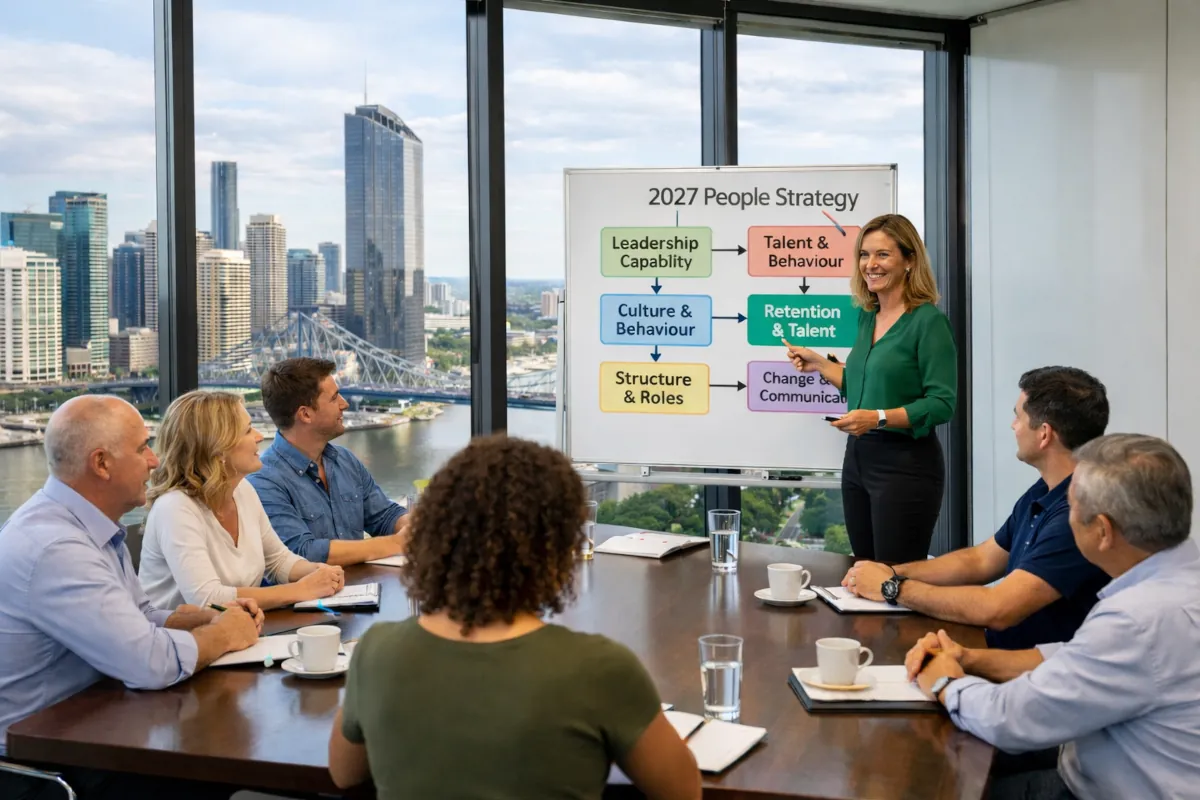
HR budget priorities should focus on people strategy, not just headcount or systems. The most effective organisations treat people spend as an investment and deliberately align it with business goals so they can improve performance, retention and culture.
Too often, budgets are built around headcount, salary increases or new technology without a clear link to the outcomes those investments are meant to drive. Without that strategic anchor, even well-funded HR initiatives can fall short.
In this article, we break down five key questions CEOs, boards and HR leaders are asking right now – and how to translate them into practical, budget-ready people priorities that deliver measurable impact.
1. What are the non‑negotiable people investments we should make in our 2027 budget if we want high performance and retention?
If you only budget for “BAU HR” – payroll, recruitment, compliance, a few generic training days – you’ll get BAU results. To genuinely lift performance and retention, you need to invest in clarity, capability and culture, not just tools and headcount.
For 2027, I’d treat these people investments as non-negotiable:
- A clear people and culture plan aligned to your 3–5 year strategy, not a list of disconnected HR projects.
- Leadership development that is contextual, practical and focused on your middle layer – the group who quietly make or break performance and culture every day.
- A simple, robust performance framework that makes expectations and feedback crystal clear, and turns “people issues” into constructive feedback and performance conversations.
- Targeted retention and succession planning for your true critical roles, not just your most visible or loudest people.
- A realistic budget for change and communication support whenever you restructure, integrate or pivot – because growth is people work.
Many organisations are also running multiple technology and transformation programs at once. On paper, each initiative makes sense; in reality, people are stretched across too many priorities, feel constantly in change mode, and are unclear what actually matters this quarter.
A core 2027 people investment is helping leaders peel back that noise: deciding which transformations really matter, sequencing them sensibly, and making sure every person knows, “Here’s what’s most important for me and my team to deliver, and here’s how it connects to the strategy.” That’s where targeted leadership support and a clear people framework turn change from burnout‑fuel into a performance lever.
These are the levers that help you get the most out of your people, because they change how work gets done, not just what you spend.
2. How do we get more out of our existing leaders without burning them out?
Many executive teams assume the answer is “send them on another leadership course.” In reality, most leaders don’t need more theory – they need clarity, experienced coaching, and a trusted executive-level advisor who can work with them on the real decisions in front of them.
If you want to get more out of your leaders in 2027:
- Strip away ambiguity: make sure each leader knows exactly what success looks like for their team this year – in business outcomes and in behaviour.
- Invest in real-world leadership capability, not just models: work with an experienced people executive who can design workshops and coaching around your actual scenarios – restructures, underperformance, conflict, rapid growth – so leaders practise on their real work, not generic case studies.
- Give them a strategic people partner: a confidential, commercially minded sounding board who understands board pressure, financial runway and risk, so your executives are not reactively solving complex people issues alone at 10pm.
- Make feedback and performance conversations normal and regular, with simple tools and rhythms that leaders can use, not a once-a-year event everyone dreads.
When leaders are clearer, more confident and better supported, you lift performance without simply asking people to “work harder”.
3. What’s the smartest way to use our HR budget – internal hires, tech, or external experts?
Most organisations overspend on tools and underspend on the strategic thinking that makes those tools useful. HR systems are only as effective as the clarity of your processes, decisions and leadership habits.
A smarter 2027 mix often looks like:
- A lean internal HR team focused on core delivery, risk and partnering with leaders’ day-to-day.
- Strategic HR and culture advisory support – fractional CHRO/CPO, project-based or interim – to design structure, operating rhythm and people strategy tied to your growth plan.
- Carefully chosen tech that supports (not dictates) your performance, talent and engagement processes, with implementation that includes change and capability building, not just configuration.
The question is not “HR generalist vs system vs consultant?” but “What combination gives us clear, commercially sound people decisions that move us towards our strategy?”
4. We’re planning a restructure or M&A in 2027 – what should be on our people risk and opportunity list?
Restructures and deals are where you can either unlock huge performance and culture upside or quietly destroy value through poor people decisions. Most of the risk sits in how you handle structure, leadership and ways of working, not just in the org chart.
For any 2027 restructure or transaction, I’d have these people priorities in your budget and plan:
- People-focused due diligence: understanding culture, leadership, key talent and “how work really gets done” before you sign, not after.
- Thoughtful organisational design that aligns structure to strategy, decision rights and accountabilities, not simply cost-cutting.
- Early identification and retention plans for critical talent on both sides of the deal.
- Clear communication, change leadership and support for middle managers, who will carry the bulk of the integration load in practice.
- A realistic period of leadership coaching or advisory support for the new top team so they can align on culture, expectations and ways of working.
In practice: why we didn’t start with the org chart
Recently I was asked to help a large organisation create a two-year financial runway, with the initial brief focused on delivering a restructure to take cost out of the business. As I spoke with the executive team and board, it became clear the bigger issue wasn’t headcount, it was misalignment. The C-suite and the board were not on the same page about strategy, priorities or what “success” needed to look like over the next two years. There was also a visible cultural divide within the organisation that started at the executive level.
We paused the restructure and held a joint board and executive strategy session. Together, we clarified the few priorities that were truly critical to the organisation’s survival and growth. Only then did we design a targeted restructure that protected and invested in the functions and skills needed to deliver those priorities, rather than applying a blunt percentage cut across the organisation.
Finally, we put a simple HR and people framework in place to shift the organisation from reactive to proactive – clearer expectations, leadership behaviours and decision rules around people and culture.
That engagement wrapped in early 2026. Since then, the team has not only met but over-achieved the critical priorities we set together, and they’ve done it from a far more aligned, confident position than if we had gone straight to a numbers-based restructure – with a cohesive narrative the whole organisation could understand and get behind, rather than a cost-cutting story that would have put trust and results at risk.
In practice: culture in acquisitions
I’ve been involved in multiple acquisitions over the years, mostly on the buy side and, in the case of ERM Power, on the sell side when Shell acquired us. One pattern shows up repeatedly: post-acquisition integration into culture is where value is quietly eroded or unlocked.
When smaller organisations are acquired by a large corporate, there is often a real difference in how they operate and make decisions. Without a deliberate plan to unify culture and ways of working, the acquired company’s processes and strengths are slowly dismissed. The corporate assumes it “knows best”, and valuable local practices vanish under standard systems and processes.
The work that really matters is creating a shared view of “how we work around here now”: which aspects of the corporate model are non‑negotiable, which elements of the acquired culture must be protected, and how leaders will signal that in everyday decisions.
When you budget for this kind of cultural integration – not just the legal, financial and systems work – you dramatically increase your chances of retaining key people and realising the deal thesis.
These are the conversations that protect value, minimise risk and help your people deliver on the business case you’ve sold to your board.
5. If we want culture to be a real performance lever in 2027, what do we actually need to fund?
Culture is not your values on a wall; it’s how things get done under pressure, when no one is watching. If you want culture to drive performance and retention in 2027, you have to budget for behaviour, not slogans.
That looks like:
- Translating values into 3-5 observable leadership behaviours and decision rules, then baking them into your processes and systems – hiring, promotions, performance and recognition.
- Equipping leaders to create psychological safety and healthy challenge, so smart people keep speaking up with ideas and risks instead of checking out.
- Simple, regular listening mechanisms – not just an annual engagement survey – that give you real insight into how it feels to work here right now.
- Clear consequence management so behaviour that undermines your culture is addressed early, not tolerated because results look good on paper.
When you fund the everyday habits that shape how work gets done, culture becomes measurable, manageable and directly linked to commercial outcomes.
How I can help
Many boards and CEOs know their leaders and people functions need support, but they’re unsure whether to treat coaching and strategic HR advisory as “nice-to-have” or core. If you’re dealing with growth, complexity, restructures, financial runway or persistent people issues, it’s core.
In practice, organisations work with me to:
- Give CEOs, founders and senior leaders a confidential, commercially minded sounding board on people, performance and culture decisions – from restructures to acquisitions to shaping culture and navigating leadership dilemmas.
- Design and stress-test people strategies, restructures and operating models before they’re announced, reducing risk, rework and cultural damage.
- Build leadership capability through tailored coaching and practical workshops anchored in your context – your priorities, your deals, your constraints – rather than generic models.
- Provide interim or fractional CHRO/CPO support when you’re between hires or not yet ready for a full-time executive, but still need executive-level judgment in the room.
Framing this as an investment in performance, retention, capital protection and risk – not a discretionary “development line” – is often what gets it over the line with boards and CFOs.
If you’re in the middle of 2027 planning and you’re not confident your people strategy is tightly aligned to your growth and risk agenda, that’s a red flag – and an opportunity. This is exactly the work I do with CEOs, founders, boards and HR leaders who want an experienced people executive in their corner without adding a full-time headcount.
If you’d like a second set of eyes on your 2027 people and culture priorities – or you need an experienced CPO-level partner to help you design them – you can book a confidential strategy call with me.